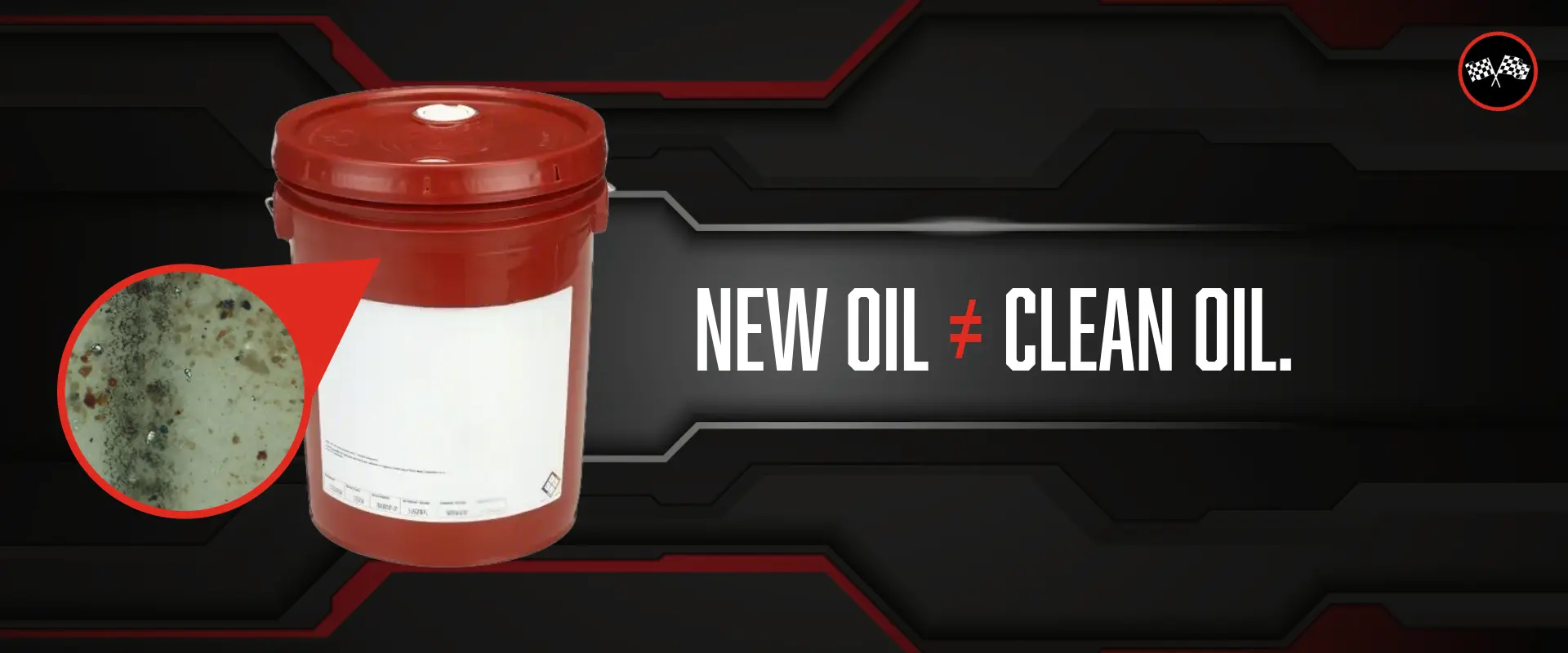
It’s commonly assumed that a sealed drum of new hydraulic oil is clean. In many cases, however, new hydraulic oil is not clean enough for a hydraulic system.
New oil is manufactured to meet specifications for viscosity, additive chemistry, oxidation stability, and other fluid properties. Particle cleanliness is a different issue.
Contamination can be introduced while the oil is produced, transported, stored, packaged, or transferred.
For hydraulic equipment with tight internal clearances, the cleanliness level of the oil entering the reservoir can matter just as much as the oil specification itself.
That is why new hydraulic oil should generally be filtered before it enters a system.
New Oil and Clean Oil Are Not the Same Thing
There is an important distinction between oil quality and oil cleanliness.
A drum of hydraulic oil can be chemically correct and still contain enough solid particles to exceed the cleanliness requirement of the hydraulic equipment.
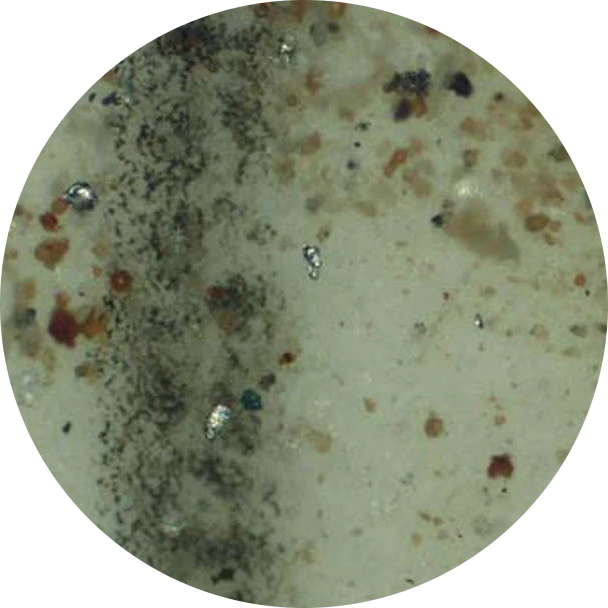
Common sources of contamination in hydraulic oil include:
- Manufacturing and blending equipment
- Storage tanks and transfer piping
- Drums, totes, and other containers
- Dust introducted during storage or handling
- Pumps, hoses, couplings, and transfer equipment
- Wear debris left inside reused transfer equipment
The oil may never look dirty. Many of the particles that matter most in a hydraulic system are far too small to see without magnification.
A human hair is roughly 70 µm in diameter. Hydraulic filtration commonly deals with particles well below 20 µm.
That difference is important because hydraulic components contain very small operating clearances. Contamination does not have to be visible to interfere with a spool valve or accelerate wear inside a pump.
Understanding ISO 4406 Cleanliness Codes
Hydraulic oil cleanliness is commonly measured using ISO 4406.
A cleanliness result may look like this:
ISO 18/16/13
Those numbers are not micron ratings. They represent the concentration of particles at three different particle-size thresholds:
| ISO Code Position | Particle Size |
|---|
| First number | ≥4 µm(c) |
| Second number | ≥6 µm(c) |
| Third number | ≥14 µm(c) |
The particle counts are measured per milliliter of fluid.
One of the most useful things to understand about ISO 4406 is that each increase of one ISO code represents approximately twice as many particles.
For example, a Code 18 concentration corresponds to approximately 1,300-2,500 particles per milliliter at that particle-size threshold. Code 19 increases to approximately 2,500-5,000.
So improving oil from ISO 20 to ISO 18 at a given particle size is not a minor change on paper. It represents roughly 75% reduction in particle concentration.
To learn more, visit Precision Filtration Product’s complete guide to ISO Cleanliness Codes.
How Clean Does Hydraulic Oil Need to Be?
There is no single ISO cleanliness code that is correct for every hydraulic system.
The target should be based primarily on the most contamination-sensitive component in the circuit. A basis cylinder circuit can tolerate more contamination than a high-pressure system using proportional or servo controls.
Typical industry guidance illustrates the difference:
| Component | Example Target Cleanliness |
|---|
| Standard hydraulic cylinder | Around ISO 20/18/15 |
| Fixed piston pump | Around ISO 18/16/14 |
| Variable piston pump | Around ISO 17/15/13 or cleaner |
| Proportional controls | Often ISO 17/15/12 or cleaner |
| Servo valve | Around ISO 16/14/11 or cleaner |
These are examples rather than universal specifications. Operating pressure and component manufacturer requirements should always be considered.
As hydraulic systems become more precise, contamination tolerance generally decreases. That creates problems with assuming that oil can be pumped directly from a drum or tote into the reservoir. Consequently, the cleanliness of the incoming oil may not match the cleanliness required by the equipment.
Why Small Particles Cause Large Problems
Large debris is easy to understand. If a visible piece of metal enters a valve, there is an obvious problem.
Fine contamination is more deceptive.
Particles near the size of internal component clearances can repeatedly pass through the system and cause gradual damage. This can lead to:
- Abrasive wear across precision surfaces
- Erosion of valve metering edges
- Increased internal leakage
- Valve spool sticking or inconsistent response
- Accelerated pump wear
- Shortened component life
Fine particulate can also create additional secondary contamination. A particle may damage a component surface, causing that wear to release more metallic debris into the oil. Those particles then circulate and create additional wear. Contamination can therefore become self-generating once it is allowed to remain in the system.
Filtering the oil before it enters the reservoir reduces the initial contaminant load the system’s filtration has to remove.
Why a Machine's Filter Shouldn't Have to Clean the New Oil
A common thought is:
“The hydraulic system already has a pre-installed filter. Why filter the oil before putting it in?”
Because the system filter is primarily there to maintain cleanliness, not compensate for unnecessarily dirty oil being added to the reservoir.
If a large volume of contaminated new oil is added during an oil change, the entire contaminant load is introduced immediately. Until that oil passes through the system filter, contaminated fluid can circulate through pumps, valves, and other components. There is also no guarantee every part of the system sees filtered oil before sensitive components are exposed.
Pre-filtration changes the process.
Instead of filling the system first and trying to clean the fluid afterward, contamination is captured during the transfer itself. The reservoir stards with cleaner oil, and the onboard filtraiton system has a much easier job maintaining the target cleanliness level.
Micron Rating Alone Does Not Tell the Whole Story
When selecting a filter for transferring hydraulic oil, the micron number should be the only specification considered.
A filter labeled “10 micron”, for example, does not automatically tell you how efficiently it captures particles at 10 µm. Filter efficiency is commonly expressed using a Beta Ratio established through multi-pass testing under ISO 16889.
A filter rated β10(c) = 200 captures approximately β10(c) = 200 captures approximately 99.5% of particles 10 µm(c) and larger under the specified test conditions.
Higher Beta Ratios indicate greater filtration efficiency. Flow rate, element dirt capacity, oil viscosity, pressure drop, and the target cleanliness level also need to be considered when selecting the filtration system.
Filter Oil During Transfer - Not After the Problem Starts
One of the easiest, most effective ways to control contamination is to stop treating the reservoir fill port as the beginning of the filtration process. Filter carts and mobile filtration systems make this process simple.
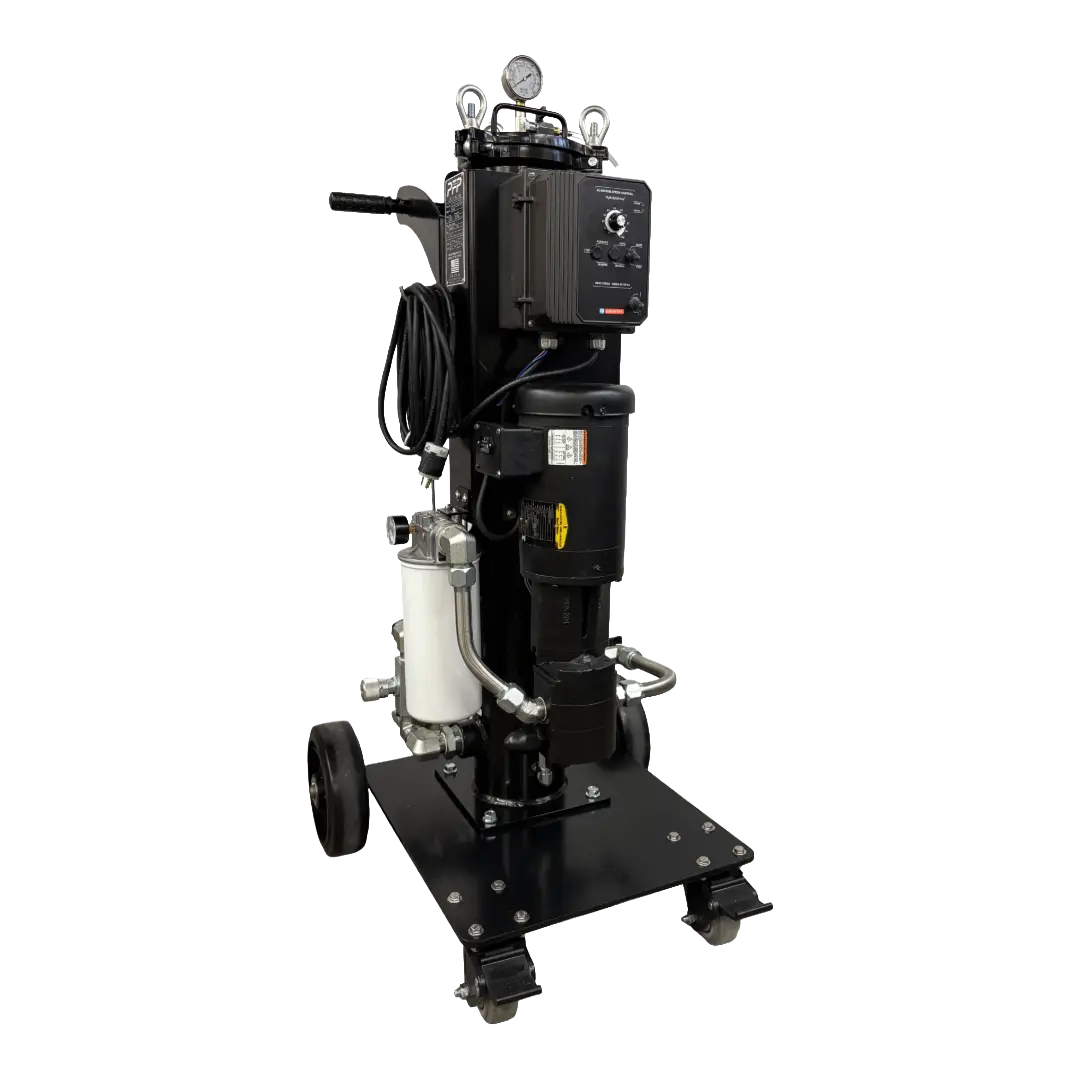
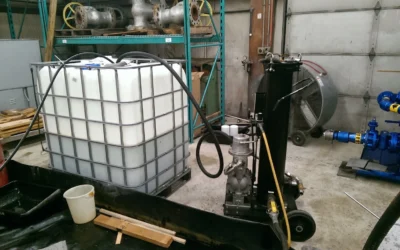
A portable filter cart can be used between the new-oil container and the reservoir. The basic process becomes:
New oil container → transfer pump → filter → hydraulic reservoir
Depending on the cleanliness requirements, oil can also be recirculated through the filtration system before or after transfer. For critical applications, a particle counter or laboratory analysis can verify that the oil actually meets the required ISO code.
Another contamination source that is easily overlooked is the equipment being used to transfer the oil.
Putting clean oil through a dirty hose defeats the entire purpose. Transfer pumps, hoses, fittings, and filter carts should be kept clean and protected between uses. Open end hoses left sitting in a maintenance area can introduce contamination before the pump is even turned on.
Dedicated transfer equipment can be especially valuable when different oils are used throughout a facility. It helps reduce both particulate contamination and accidental cross-contamination between incompatible fluids.
Good oil handling starts before the oil reaches the machine.
Make Clean Oil the Starting Point with Performance Filtration Products
Performance Filtration Products provides standard and custom filtration equipment and replacement filter elements for hydraulic and lubrication applications. Our portable filter carts and custom filtration systems can be configured around required flow rates, fluid viscosity, filter efficiency, and target cleanliness levels.
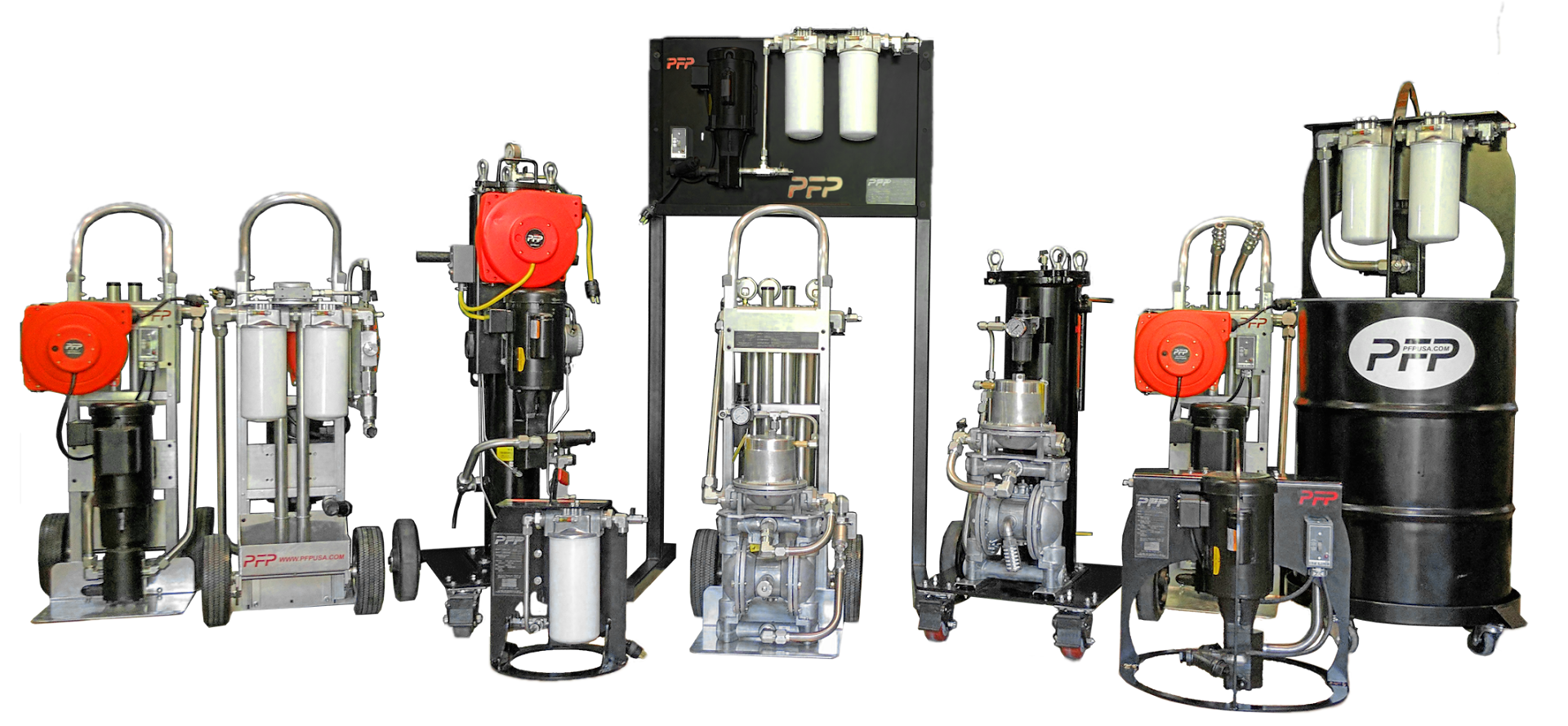
In addition to mobile filter equipment manufacturing, we offer auxiliary equipment to provide a fully turnkey solution to our customers.
We considate filtration solutions into a single source to make resolving filtration challenges as frictionless as possible.

Looking for hydraulic oil filtration equipment?
Whether you need a custom or standard filtration system, Performance Filtration Products can deliver a turnkey solution directly to our facility. Contact our engineers to discuss your unique application requirements.
To speak with an engineer, call (888) 679-6645


0 Comments